
Autonomous Vehicles & Self-Driving Cars
Autonomous Vehicles
& The Future of Driving
From advanced driver-assistance technology to the possibility of fully
self-driving vehicles, automotive innovation is changing how we think
about the road ahead. Discover what autonomous driving really means,
how the six levels of automation work, where Cadillac Super Cruise
fits today, and why GM is preparing eyes-off driving for the ESCALADE IQ.
What Is an Autonomous Vehicle?
An autonomous vehicle uses a combination of technologies that may
include cameras, radar, sensors, GPS, mapping, computer processing
and advanced software to assist with — or, at higher levels of
automation, perform — driving tasks.
But autonomous, self-driving,
hands-free and driver assistance do not all mean the same thing.
The amount of responsibility assigned to the vehicle versus the
human driver depends on the vehicle’s level of driving automation.
Driver Assistance vs. Autonomous Driving
Understanding these terms makes it easier to know what today’s
vehicle technology can — and cannot — do.
Driver Assistance
Technology assists the driver with certain driving functions,
but the driver remains responsible for operating and monitoring
the vehicle.
Hands-Free Driving
Certain systems may allow the driver to remove their hands
from the steering wheel under specific conditions while still
requiring continuous driver attention.
Autonomous Driving
At higher levels of automation, the automated driving system
performs the complete driving task under defined conditions
with progressively less human involvement.
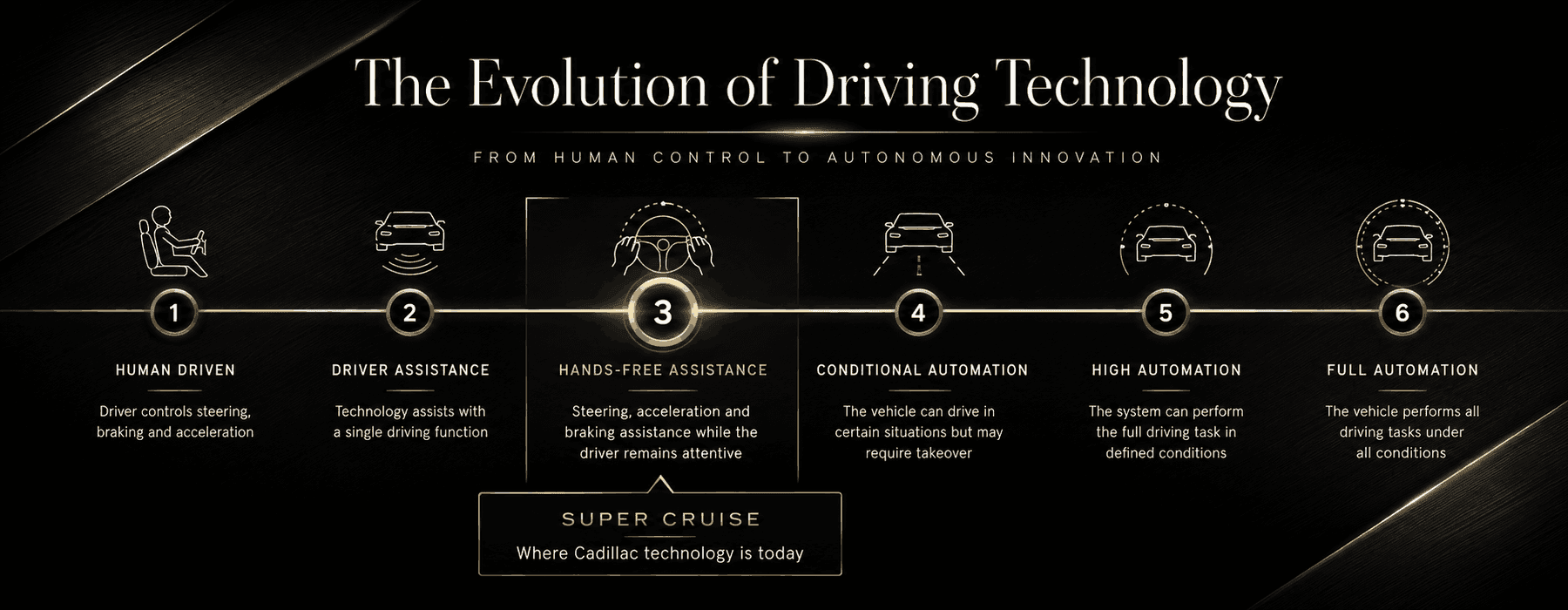
The Six Levels of Driving Automation
Driving automation ranges from Level 0, where the human driver
performs the driving task, through Level 5, where an automated
driving system could perform the complete driving task.
No Driving Automation
The driver controls steering, acceleration and braking.
Technology may provide warnings or momentary assistance.
Driver Assistance
The vehicle can continuously assist with either steering
or acceleration and braking, but the human driver remains
responsible for driving.
Additional Driving Assistance
Technology can continuously assist with steering and
acceleration or braking simultaneously. The driver must
remain attentive and supervise the system.
Conditional Automation
The automated system handles driving within approved conditions.
The driver need not continuously monitor the road when it is active,
but must be ready to respond to a takeover request.
High Automation
The system can perform the complete driving task within
defined operating areas or conditions without requiring
a human driver to take control.
Full Automation
The automated driving system performs the complete driving
task under all roadway and environmental conditions for
which a human could normally drive.
Where Does
Super Cruise®
Fit?
Available Cadillac Super Cruise is an advanced hands-free
driver-assistance technology designed for use on compatible roads.
When operating conditions are met, Super Cruise can help manage
steering, acceleration and braking while helping keep the vehicle
positioned within its lane.
A Driver Attention System helps monitor whether the driver
is paying attention to the road.
Super Cruise does not turn a Cadillac into a fully
autonomous vehicle. The driver must remain attentive
and prepared to take control.
Super Cruise May Utilize
The Next Step: Eyes-Off Driving in the Cadillac ESCALADE IQ
General Motors plans to introduce eyes-off highway driving capabilities as early as 2028, starting with the Cadillac ESCALADE IQ. This represents a planned advancement beyond today’s attentive-driver Super Cruise system, not a feature currently offered on vehicles for sale.
Super Cruise: Hands-Free, Eyes-On
On compatible roads and under appropriate conditions, available Super Cruise can assist with steering, acceleration and braking. The driver must continuously pay attention to the roadway and be ready to intervene.
Hands off the wheel does not mean eyes off the road.
ESCALADE IQ: Next-Generation Automation
GM is developing a system intended to permit drivers to look away from the road while the system handles driving on compatible highways and within specified conditions. Drivers may still need to respond to system requests to resume control.
Future capability; not currently available. Launch timing is subject to change.
How GM Is Preparing for Eyes-Off Driving
In March 2026, GM announced supervised public-road testing of its next-generation automated-driving technology on limited-access highways in California and Michigan. Testing and simulation help engineers evaluate real-world situations before introducing new capabilities to customers.
In April 2026, GM announced that customers had driven one billion hands-free miles with Super Cruise. That experience supports its continued development of advanced driver-assistance and automated-driving systems.
GM has described a planned eyes-off system that uses multiple sensing technologies, including cameras, radar and lidar, and initially focuses on compatible highways. Its actual capabilities, availability and conditions will depend on development, validation and other factors.
Does Hands-Free Mean Self-Driving?
No. A vehicle can offer hands-free driver assistance
without being an autonomous vehicle. With systems such as Cadillac
Super Cruise, drivers must continue watching the road and remain
prepared to take control of the vehicle.
Hands-free does not mean attention-free.
Technology Behind Automated Driving
Advanced vehicles can use multiple technologies simultaneously
to understand the vehicle’s position, surroundings and roadway.
Cameras
Cameras can help identify lane markings, vehicles,
road features and other visual information surrounding
the vehicle.
Radar & Sensors
Radar and other sensors can help determine the position,
distance and movement of objects around the vehicle.
GPS & Mapping
Positioning technology and detailed mapping can help determine
where the vehicle is and provide information about the road ahead.
Vehicle Software
Sophisticated software processes information from multiple
vehicle systems and determines how driver-assistance features
should respond.
Driver Monitoring
Some advanced driver-assistance systems monitor driver
attention to help ensure the human driver remains engaged.
Connectivity
Connected vehicle technology can support mapping,
positioning, software and other services used by advanced
vehicle systems.
What Could Autonomous Vehicles Change?
As automated-driving technology continues to develop,
manufacturers, technology companies and regulators are
studying how greater levels of automation could affect
transportation.
Safety
Advanced automation is being developed with the potential
to reduce certain types of crashes associated with human
driving errors.
Mobility
Higher levels of automation could eventually provide
additional transportation options for people who cannot
drive independently.
Convenience
Driver-assistance technology is already changing the
experience of highway travel, commuting and long-distance
driving.
Autonomous Vehicle FAQs
What is an autonomous vehicle?
system capable of performing some or all of the driving task.
The amount of human involvement depends on the vehicle’s
automation level.
Are self-driving and autonomous vehicles the same thing?
conversation, but driving automation ranges from basic
assistance through full automation. It is more accurate
to identify the specific level and capability of the system.
How many levels of autonomous driving are there?
Levels 0 through 2 require the human driver to supervise the
driving environment. Levels 3 through 5 progressively transfer
more driving responsibility to the automated driving system.
Is Cadillac Super Cruise autonomous driving?
driver-assistance technology. The driver must remain attentive
to the road and ready to take control when needed.
Can you take your eyes off the road while using Super Cruise?
using Super Cruise. A Driver Attention System helps monitor
driver attention while the feature is operating.
Does hands-free driving mean the vehicle drives itself?
driver-assistance systems. It does not mean that the vehicle
is fully autonomous or that the driver can stop supervising
the vehicle.
Can Super Cruise avoid objects in the road?
Drivers remain responsible for monitoring roadway conditions,
objects, pedestrians, animals, construction and other hazards
and must take control when necessary.
Are fully autonomous cars available to consumers today?
driver-assistance technologies rather than universal
Level 4 or Level 5 self-driving capability.
Which Cadillac vehicles offer Super Cruise?
and model year. Contact Kelly Cadillac to confirm Super Cruise
availability on a specific vehicle.
Can I experience Super Cruise at Kelly Cadillac?
about current Super Cruise-equipped inventory and available
demonstrations or test drives.
When will Cadillac offer eyes-off driving?
How is eyes-off driving different from Super Cruise?
The Future of Driving Is Already Taking Shape.
Explore Cadillac vehicles featuring some of today’s most advanced
driver-assistance technologies at Kelly Cadillac in Lancaster, PA.
Our team can help you understand the technology, available features
and which Cadillac is right for you.
Driver Assistance Technology Disclaimer:
Vehicle features, capabilities and availability vary by model, model year, trim, equipment, software and operating conditions. Driver-assistance technologies are not substitutes for safe and attentive driving. Always remain attentive while driving and follow all applicable laws, vehicle instructions and Owner’s Manual guidance. Super Cruise functionality requires compatible roads and other operating conditions. Super Cruise is SAE Level 2 assistance and requires the driver to keep eyes on the road. GM’s eyes-off functionality is planned for introduction as early as 2028, initially on the Cadillac ESCALADE IQ; it is not currently offered, and timing, conditions and availability are subject to development, validation, regulations and change. See Cadillac and your vehicle’s Owner’s Manual for complete feature limitations and requirements.
